The Bug-Rivet Paradox

The bug-rivet paradox is a variation on the twin paradox and is similar to the pole-barn paradox in that the ideas of simultaneity in relativity must be addressed. The fact that two events are simultaneous in one frame of
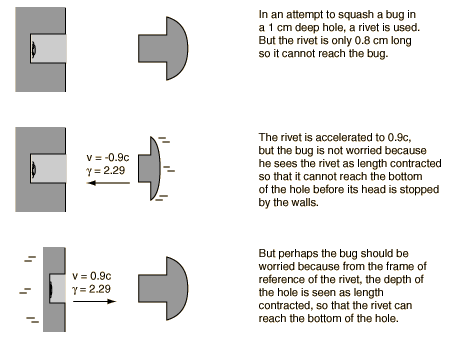
To calculate the times for the two frames of

Rivet frame of

The rivet is considered to the be the
  • End of rivet enters hole: t' = 0
  • Rivet head hits wall: t' = 0.8 cm/0.9c = 29.63 ps
  • Rivet end hits length-contracted bottom of hole: t' = 1 cm/0.9cg = 16.14 ps

The end of the rivet hits the bottom of the hole before the head of the rivet hits the wall. So it looks like the bug is squashed.

Bug frame of
  • Front of rivet enters hole: t = 0
  • Head of rivet hits wall: t = 0.8 cm/0.9cγ = 12.91 ps

All this is nonsense from the bug's point of view. The rivet head hits the wall when the rivet end is just 0.35 cm down in the hole! The rivet doesn't get close to the bug.

Transforming the times measured in the bug's frame of
  • Rivet head impact time t' = γ(12.9 ps) = 29.63 ps
  • Rivet end in bug frame is simultaneously at x=-.35 cm, but it is not simultaneous in the rivet frame. Transforming gives t' =γ(12.9 ps - .9c(.0035)/c2) = 5.63 ps.
  • If you try to find a rivet frame time when the rivet end hits the bottom of the hole, x = -1 cm, t' =γ(37.04 ps - .9c(.01)/c2) = 16.14 ps.

Transforming times from the bug frame to the rivet frame gives a time for the end to reach -0.35 cm before the rivet head hits, and even suggests that it reaches the bottom of the hole before the rivet head hits. The paradox is not resolved.

The Pole-Barn Paradox
Index  
Relativity  
Go Back