Clocked Set-Reset Flip-flop
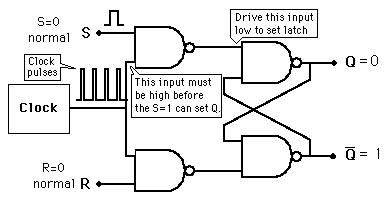
Example Output

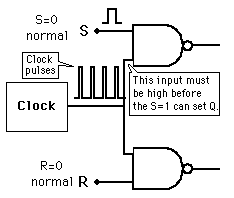
When the signal line S goes high, the other line to the NAND gate from the pulse steering circuit must also be high for it to generate a low output. Likewise, a clock pulse must have the reset NAND gate high to receive a high RESET pulse. Therefore all transitions are synchronized to the clock.

Set-reset Flip-flopNAND-gate Latch
Index

Electronics concepts

Digital circuits
 
Electricity and magnetism 
Go Back


Pulse-Steering Circuit

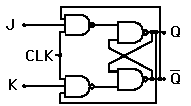
In the case of the J-K flip-flop, the pulse steering circuit is tied to the output lines past the NAND gate latch. This gives it the toggle action when J and K are both high.

In order to add clock synchronization to a flip-flop, a ciruit is used to apply the clock pulses to the flip-flop. To convert a NAND gate latch to a clocked S/R flip-flop, two NAND gates may be used as above left to enable an input pulse on either the S or R lines to trigger a transition.

NAND-Gate Latch
Index

Electronics concepts

Digital circuits
 
Electricity and magnetism 
Go Back


Resetting the NAND Latch

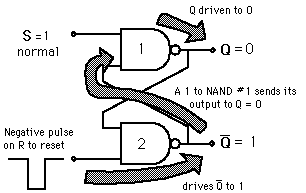
Return to reset state.

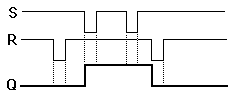
The time sequence at right shows the conditions under which the set and reset inputs cause a state change, and when they don't.

NAND-Gate Latch
Index

Electronics concepts

Digital circuits
 
Electricity and magnetism 
Go Back