NAND-gate Latch

Apply "Set" Pulse

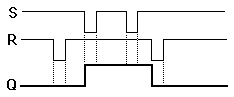
The time sequence at right shows the conditions under which the set and reset inputs cause a state change, and when they don't.

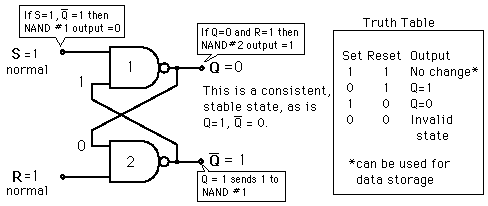
The concept of a "latch" circuit is important to creating memory devices. The function of such a circuit is to "latch" the value created by the input signal to the device and hold that value until some other signal changes it.

Application to switch de-bouncing
Set-reset Flip-flopNOR-gate Latch
To Clocked VersionNAND Gate
Application in D Flip-flop
Index

Electronics concepts

Digital circuits
 
Electricity and magnetism 
Go Back


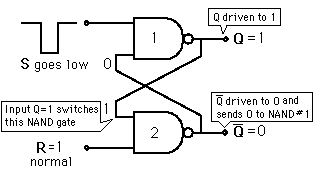
Setting the NAND Latch

After being set to Q=1 by the low pulse at S (NAND gate function), the restored normal value S=1 is consistent witht the Q=1 state, so it is stable. Another negative pulse on S gives which does not switch the flip-flop, so it ignores further input.
Apply "Reset" Pulse

The time sequence at right shows the conditions under which the set and reset inputs cause a state change, and when they don't.

NAND-Gate Latch
Index

Electronics concepts

Digital circuits
 
Electricity and magnetism 
Go Back


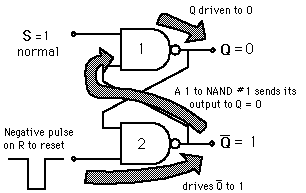
Resetting the NAND Latch

Return to reset state.

The time sequence at right shows the conditions under which the set and reset inputs cause a state change, and when they don't.

NAND-Gate Latch
Index

Electronics concepts

Digital circuits
 
Electricity and magnetism 
Go Back