Photopic Vision
|
The Photopic efficacy curve was extrapolated from testing done on 'Standard Observers'. This was done by taking a person with normal vision, and having them compare the brightness of monochromatic light at 555 nm, where the eye is most sensitive, with the brightness of another monochromatic source of differing wavelength. To achieve a balance, the brightness of the 555 nm source was reduced until the observer felt that the two sources were equal in brightness. The fraction by which the 555 nm source is reduced measures the observer's sensitivity to the second wavelength. This exercise is repeated through many wavelengths and many observers. The average of the results gives us the relative sensitivity of the eye at various wavelengths. In 1924, the International Commission on Illumination adopted the "relative sensitivity curve for the C.I.E. Standard Observer".
|
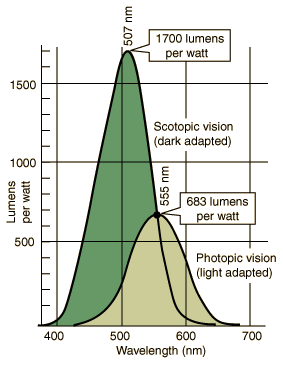
Each wavelength has a relative value for the Standard Observer's sensitivity, the luminous efficacy at that wavelength, Vl. The value of Vl is designated as unity at 555 nm and decreases to zero at the ends of the visible spectrum. This is associated with the daylight vision of the human eye, also known as photopic vision. In lowlight conditions, the efficacy curve shifts toward the blue end of the spectrum due to the sensitivity of the eye. Chemical changes in the eye at night shift our vision to the scotopic range. This differentiation between light and dark vision is caused by the activity of the rods and cones in the retina, and their sensitivity to light.
At 555 nm, this efficacy translates to a luminous flux of 683 lumens/W, and thus a fraction of that value at wavelengths to either side of the visible spectrum. This value is derived from the definition of the candela directly.
|
Index
Vision concepts
|