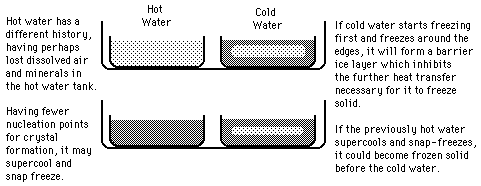
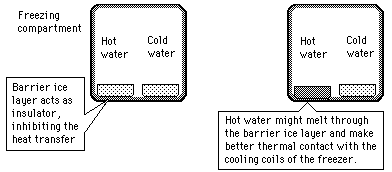
Hot Water Freezing?The rumor persists that hot water will freeze faster than cold water. It sounds implausible because the hot water has more internal energy which must be removed before it can start the phase change. Perhaps this tale had its origin in the days of non-frost-free refrigerators in which a considerable buildup of ice on the walls of the freezing compartment was a common occurrence. Ice acts as an insulator, inhibiting the cooling process. ![]()
|
Index Heat questions | ||
| Thermodynamics | Go Back |
What about snap-freezing?Another scenario suggested for the "hot water freezing" story is the possibility of supercooling and snap-freezing by the hot water. ![]()
|
Index Heat questions | |
| Thermodynamics | Go Back |
The Mpemba EffectThere is in fact a large body of literature about initially hot water freezing faster than cold water and this phenomenon has been labeled the "Mpemba effect" (see |
Index Heat questions |
| Thermodynamics | Go Back |
Cooling CoffeeLeave it black for a while, then add cream.The intent is to get the coffee cool enough to drink in the shortest possible time. The heat loss rate by conduction, convection, and radiation all depend upon the difference in temperature between the hot object and its surroundings. Therefore the cooling rate is greater if you don't immediately add cream.
|
Index Heat questions | ||
| Thermodynamics | Go Back |
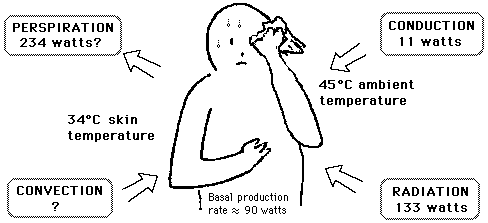
Cooling on very hot day?![]() The standard heat transfer mechanisms act against you, transferring heat into your body on a very hot day. The main cooling mechanism you have available is the evaporation of perspiration. Fortunately, it is a very effective mechanism because of the large heat of vaporization of water. Note that you must continue to have a net outflow of about 90 watts, even on a hot day.
|
Index Heat questions | ||
| Thermodynamics | Go Back |
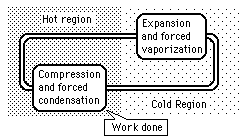
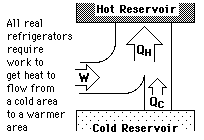
Heat Flow to Hotter RegionAlthough internal energy will not spontaneously flow from a hot region to a cold region, it can be forced to do so by doing work on the system. Refrigerators and heat pumps are examples of heat engines which cause energy to be transferred from a cold area to a hot area. Usually this is done with the aid of a phase change, i.e., a refrigerant liquid is forced to evaporate and extract energy from the cold area. Then it is compressed and forced to condense in the hot area, dumping its heat of vaporization into the hot area.
|
Index Heat questions | ||
| Thermodynamics | Go Back |