Stellar Spectral Types
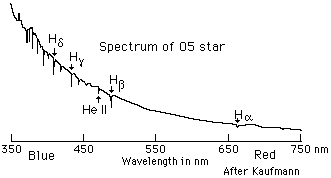
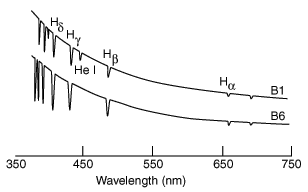
Stars can be classified by their surface temperatures as determined from Wien's Displacement Law, but this poses practical difficulties for distant stars. Spectral characteristics offer a way to classify stars which gives information about temperature in a different way - particular absorption lines can be observed only for a certain range of temperatures because only in that range are the involved atomic energy levels populated. The standard classes are:
| | Temperature | |
| O | 30,000 - 60,000 K | Blue stars |
| B | 10,000 - 30,000 K | Blue-white stars |
| A | 7,500 - 10,000 K | White stars |
| F | 6,000 - 7,500 K | Yellow-white stars |
| G | 5,000 - 6,000 K | Yellow stars (like the Sun) |
| K | 3,500 - 5,000K | Yellow-orange stars |
| M | < 3,500 K | Red stars |
The commonly used mnemonic for the sequence of these classifications is "Oh Be A Fine Girl, Kiss Me".
Spectral Class Characteristics
Data from J. C. Evans, George Mason University
| Spectral Class |
Intrinsic Color |
Temperature (K) |
Prominent Absorption Lines |
| O |
Blue |
41,000 |
He+, O++, N++, Si++, He, H |
| B |
Blue |
31,000 |
He, H, O+, C+, N+, Si+ |
| A |
Blue-white |
9,500 |
H(strongest), Ca+, Mg+, Fe+ |
| F |
White |
7,240 |
H(weaker), Ca+, ionized metals |
| G |
Yellow-white |
5,920 |
H(weaker), Ca+, ionized & neutral metal |
| K |
Orange |
5,300 |
Ca+(strongest), neutral metals strong, H(weak) |
| M |
Red |
3,850 |
Strong neutral atoms, TiO |
|
Index
Star concepts |