The Junction Transistor

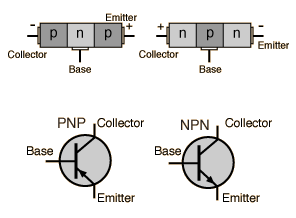
A bipolar junction transistor consists of three regions of doped semiconductors. A small current in the center or base region can be used to control a larger current flowing between the end regions (emitter and collector). The device can be characterized as a current amplifier, having many applications for amplification and switching.
Constraints on operationTransistor operating conditions
Varieties of TransistorsDetails about conduction in transistors
Determining collector currentDetails about base-emitter junction
Index

Semiconductor concepts

Semiconductors for electronics

Electronics concepts
 
Condensed Matter  
Go Back


Transistor as Current Amplifier

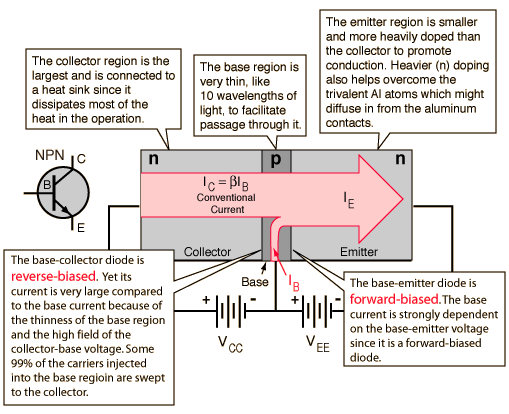
The larger collector current IC is proportional to the base current IB according to the relationship IC =βIB , or more precisely it is proportional to the base-emitter voltage VBE . The smaller base current controls the larger collector current, achieving current amplification.
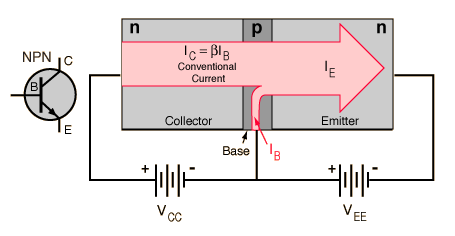
The analogy to a valve is sometimes helpful. The smaller current in the base acts as a "valve", controlling the larger current from collector to emitter. A "signal" in the form of a variation in the base current is reproduced as a larger variation in the collector-to-emitter current, achieving an amplification of that signal.

Constraints on operationComments on structureTo pnp version
Index

Semiconductor concepts

Semiconductors for electronics

Electronics concepts

 
Condensed Matter  
Go Back


Transistor Structure


The junction transistorCurrent amplifier operation Constraints on operation
Index

Semiconductor concepts

Semiconductors for electronics

Electronics concepts
 
Condensed Matter  
Go Back


Transistor as Current Amplifier

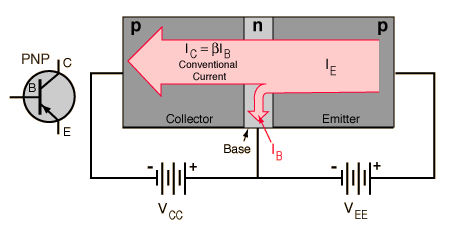
The larger collector current IC is proportional to the base current IB according to the relationship IC =βIB , or more precisely it is proportional to the base-emitter voltage VBE . The smaller base current controls the larger collector current, achieving current amplification.

Constraints on operationTo npn version
Index

Semiconductor concepts

Semiconductors for electronics

Electronics concepts
 
Condensed Matter  
Go Back


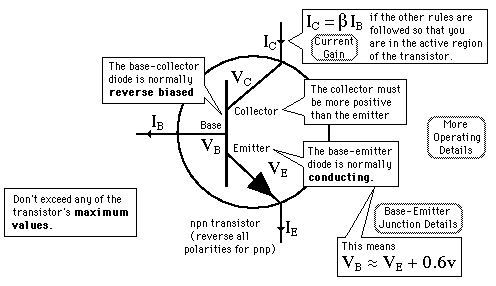
Constraints on Transistor Operation

The bold text and the "buttons" are active links to further details.
Index

Semiconductor concepts

Semiconductors for electronics

Electronics concepts
 
Condensed Matter  
Go Back


Transistor Maximum Values

Part of the manufacturer's data for transistors is a set of maximum values which must not be exceeded in its operation. These form some of the constraints on transistor operation which are a part of the design of any circuit. A typical set, for the silicon transistor 2N2222:

  • Collector-Base Voltage = 60 v
  • Collector-Emitter Voltage = 30 v
  • Base-Emitter Voltage = 5 v
  • Power dissipation = 500 mW
  • Temperature 125 C
Index

Semiconductor concepts

Semiconductors for electronics

Electronics concepts
 
Condensed Matter  
Go Back