Principle of Equivalence

Experiments performed in a uniformly accelerating
Index

General relativity ideas
 
Relativity  
Go Back


Advance of Mercury's Perihelion
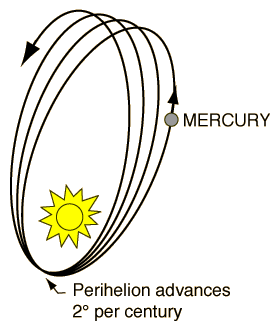
The perihelion of the orbit of the planet Mercury advances 2 degrees per century. 80 seconds of that advance was accounted for by perturbations from the other planets, etc., but the last 40 seconds of arc were unaccounted for. General relativity predicts an additional 43 seconds of arc and was one of the first triumphs of Einstein's theory.

The eccentricity of Mercury's orbit is exaggerated here to emphasize the effect.

More numerical detail

Index

General relativity ideas

 
Relativity  
Go Back


Advance of Mercury's Perihelion

According to Roy D. North, more precise numbers are as follows (in arcsec per Julian century):
5599 total advance with respect to to geocenter (our
5025 contribution of precession of Earth's equinoxes.
531 Classical or Newtonian contribution of the other planets.
43 General relativity correction (modern theory: 42.98)
Greater perihelion advances with binary pulsars.
Index

General relativity ideas

 
Relativity  
Go Back


Gravitational Deflection of Light

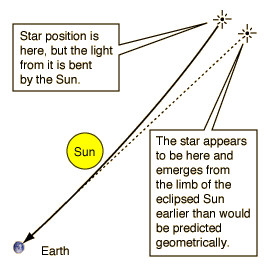
Einstein's calculations in his newly developed general relativity indicated that the light from a star which just grazed the sun should be deflected by 1.75 seconds of arc. It was tested during the total eclipse of 1919 and during most of those which have ocurred since.

This bending of light can produce a gravitational lensing effect if a distant galaxy or quasar is closely aligned with a massive galaxy closer to us. If one galaxy is directly behind another, the result can be a circle of light called an Einstein ring.

Index

General relativity ideas

 
Relativity  
Go Back