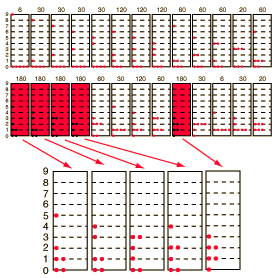
The average distribution of 9 units of energy among 6 identical particles
| E | Average
number
Maxwell-
Boltzmann | Average
number
Bose-
Einstein | Average
number
Fermi-
Dirac |
| 0 | 2.143 | 2.269 | 1.8 |
| 1 | 1.484 | 1.538 | 1.6 |
| 2 | 0.989 | 0.885 | 1.2 |
| 3 | 0.629 | 0.538 | 0.8 |
| 4 | 0.378 | 0.269 | 0.4 |
| 5 | 0.210 | 0.192 | 0.2 |
| 6 | 0.105 | 0.115 | 0 |
| 7 | 0.045 | 0.077 | 0 |
| 8 | 0.015 | 0.038 | 0 |
| 9 | 0.003 | 0.038 | 0 |
|
|
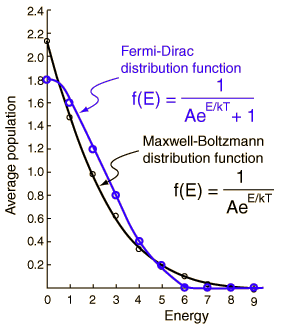
For fermions, there are only 5 possible distributions of 9 units of energy among 6 particles compared to 26 possible distributions for classical particles. To get a distribution function of the number of particles as a function of energy, the average population of each energy state must be taken. The average for each of the 9 states is shown above compared to the results obtained by Maxwell-Boltzmann statistics and Bose-Einstein statistics .
Low energy states are less probable with Fermi-Dirac statistics than with the Maxwell-Boltzmann statistics while mid-range energies are more probable. While that difference is not dramatic in this example for a small number of particles, it becomes very dramatic with large numbers and low temperatures. At absolute zero all of the possible energy states up to a level called the Fermi energy are occupied, and all the levels above the Fermi energy are vacant.
|