Rubidium/Strontium Dating of Meteorites
The study of the rubidium/strontium isotopic ratios in a set of meteorite samples shows the general approach to this kind of radioactive dating. The isotope 87Rb decays into the ground state of 87Sr with a half-life of 4.7 x 10¹⁰ years and a maximum b- energy of 272 keV. 86Sr is of non-radiogenic origin and can be used as a
From an example by Jelley, the following five chondritic meteorites are reported to have the following proportions of the rubidium and strontium isotopes:
| Meteorites | ||
| Modoc | ||
| Homestead | ||
| Bruderheim | ||
| Kyushu | ||
| Buth Furnace |
This data was plotted with the spreadsheet Excel as shown below.
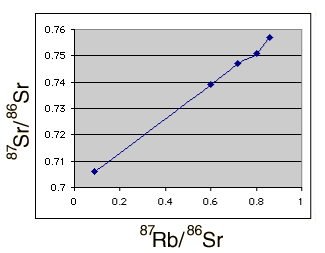
The age consistent with the slope of this plot can be calculated in a way which makes use of the non-radiogenic 86Sr as a
While the consistency is remarkable, there are uncertainties. A glance at the plot above shows that the Homestead meteorite is a bit off the line with the others. In fact, if just an average of the point-to-point slopes for all the data points is used, including the Homestead meteorite, an age of 4.7 billion is obtained, showing that there is a significant uncertainty in the dates obtained. The 4.6 billion year value was obtained by eliminating the Homestead meteorite, since that appeared to give a more consistent slope for the curve. This is all the data I have about these particular samples - comments about this scenario are invited.
| Nuclear |