Cesium-137
Cesium-137 and strontium-90 are the most dangerous radioisotopes to the environment in terms of their long-term effects. Their intermediate half-lives of about 30 years suggests that they are not only highly radioactive but that they have a long enough halflife to be around for hundreds of years. Iodine-131 may give a higher initial dose, but its short halflife of 8 days ensures that it will soon be gone. Besides its persistence and high activity, cesium-137 has the further insidious property of being mistaken for potassium by living organisms and taken up as part of the fluid electrolytes. This means that it is passed on up the food chain and reconcentrated from the environment by that process.
| Cesium-137 decay has a half-life of 30.07 years and proceeds by both beta decay and gamma emission from an intermediate state. Both the electron and gamma emissions are highly ionizing radiation. The gamma radiation is very penetrating, and the beta radiation, though very short range, is very dangerous when ingested because it deposits all that energy in a very short distance in tissue. | 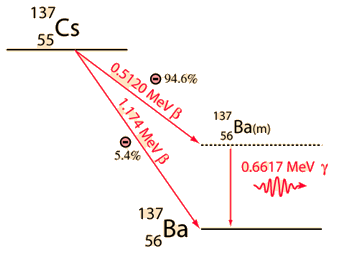 |
Cesium's danger as an environmental hazard, damaging when ingested, is made worse by it's mimicing of potassium's chemical properties. This ensures that cesium as a contaminant will be ingested, because potassium is needed by all living things.
Strontium-90 is not quite as likely as cesium-137 to be released as a part of a nuclear reactor accident because it is much less volatile, but is probably the most dangerous component of the radioactive fallout from a nuclear weapon.
Strontium-90 undergoes beta decay, emitting electrons with energy 0.546 MeV with a half-life of 28.8 years. The decay product is yttrium-90.
|