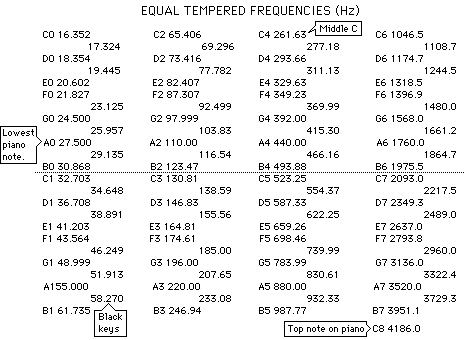
Equal Temperament
The equal tempered scale is the common musical scale used at present, used for the tuning of pianos and other instruments of relatively fixed scale. It divides the octave into 12 equal semitones. It is common practice to state musical intervals in cents, where 100¢ is defined as one equal tempered semitone. The cents notation provides a useful way to compare intervals in different temperaments and to decide whether those differences are musically significant. A useful parameter for comparison is the just noticeable difference in pitch which corresponds to about 5¢.

One of the advantages of the equal tempered scale is that it is the same in any musical "key", so that compositions may be freely transposed up or down without changing the musical intervals. This is such a major advantage that it has made equal temperament the standard temperament in western music for the past 200 years. The equal tempered intervals may be compared with Just and Pythagorean temperaments which maintain the exact-integer-ratio rule for the main intervals, while equal temperament departs from that standard.
The piano keyboard is the standard example of the equal tempered scale, and the frets on a modern guitar are also placed to fix the instrument into the equal tempered scale.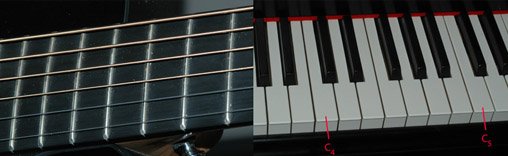
| Equal tempered frequency list |
| Equal tempered octave on the piano |
| Equal tempered octave vs other temperaments |
Temperament and musical scales
| Sound |