Carbon Resistors
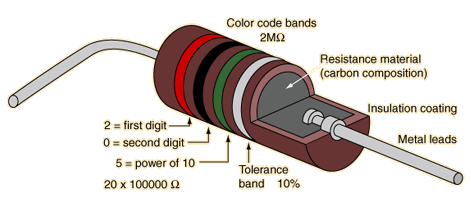
There are many types of resistors, both fixed and variable. The most common type for electronics use is the carbon resistor. They are made in different physical sizes with power dissipation limits commonly from 1 watt down to 1/8 watt. The resistance value and tolerance can be determined from the standard resistor color code.
|
A variation on the color code is used for precision resistors which may have five colored bands. In that case the first three bands indicate the first three digits of the resistance value and the fourth band indicates the number of zeros. In the five band code the fifth band is gold for 1% resistors and silver for 2%. There is another scheme for resistors which have the values stamped on them. Since a decimal point is easy to miss, this code uses R instead of a decimal point. For values over 100 W four numbers are used. The tolerance is indicated by a letter. Examples: | ||||||||||||||||||||||||||||||||||||||||||
| Discussion of resistance |
Electronics concepts
| Electricity and magnetism |