Lightning
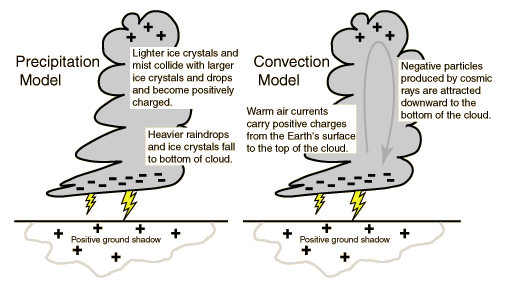
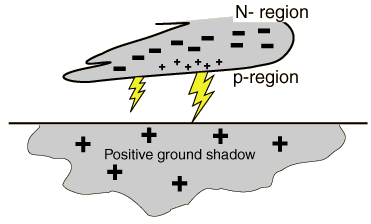
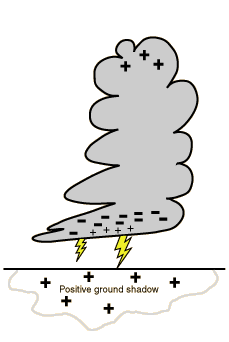
Models for the charge buildup which leads to lightning discharges suggest a buildup of a strong negative charge layer near the bottom of the cloud and the formation of a positive ground shadow. When the buildup is large enough to produce ionization of the air, a lightning discharge is initiated. This is called the positive dipole structure for the charge buildup. More recent studies indicate a tripolar structure. With voltages of hundreds of millions of volts and currents in the tens of thousands of amperes, lightning flashes can be very destructive. Most of the information in this section comes from E. R. Williams' Scientific American article "The Electrification of Thunderstorms" or from Martin Uman's classic book "Lightning". |
|
Where will lightning strike?
This is certainly a plausible question, and you can answer that it will take the path of least resistance to the Earth. But the classic response is to say "That is like asking where the 800 pound gorilla is going to sit. Anywhere he wants!" That is not to say that there are no physical laws involved, it is just that there are many variables and a degree of chaos in the environment of the charge. In a medium which could be classified as "nonlinear", implying that it doesn't follow simple proportionalities, the path of the lightning strike is not predictable in practice. As an example of this kind of variability, electric discharges can be produced with a Tesla coil. The path of the discharge changes drastically with time, even though the voltage and the nature of the surrounding air are reasonably constant.
Lightning concepts
| Electricity and Magnetism |