|
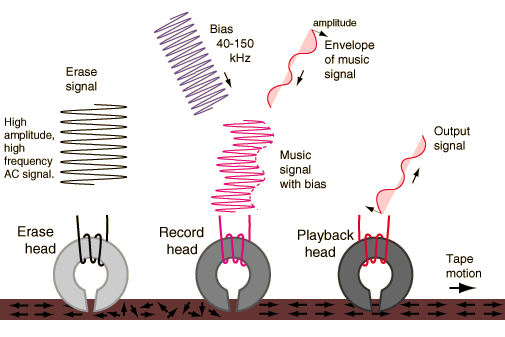
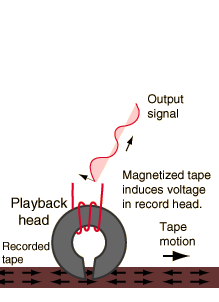
When a magnetized tape passes under the playback head of a tape recorder, the ferromagnetic material in the tape head is magnetized and that magnetic field penetrates a coil of wire which is wrapped around it. Any change in magnetic field induces a voltage in the coil according to Faraday's law. This induced voltage forms an electrical image of the signal which is recorded on the tape.
Problem: The magnetization of the magnetic emulsion is proportional to the recorded signal while the induced voltage in the coil is proportional to the rate at which the magnetization in the coil changes. This means that for a signal with twice the frequency, the output signal is twice as great for the same degree of magnetization of the tape. It is therefore necessary to compensate for this increase in signal to keep high frequencies from being boosted by a factor of two for each octave increase in pitch. This compensation process is called equalization. |