Energy in Radiation in the Early Universe
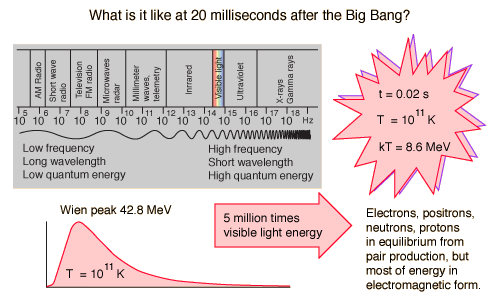
Electromagnetic radiation and the flux of neutrinos were the dominant form of energy in the early universe, becoming more dominant as one models earlier times in the big bang. It is reminiscent of the Biblical phrase "Let there be light". But of course this is not visible light but far beyond gamma rays since the average photon energy increases as one models earlier times and photon energies become high enough to accomplish pair production of all known particles. For example at a temperature of 1011 K, modeled at a time of about 20 milliseconds into Weinberg's model of the big bang, the thermal energy kT = 8.6 MeV. At this temperature, the peak energy given by the Wien displacement law is 42.8 MeV. The radiation energy was sufficient not only for electron-positron pair production, but also to maintain essentially equal populations of protons and neutrons. So in that era, radiation was truly dominant.
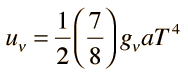
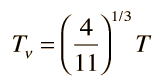
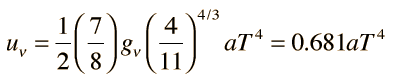
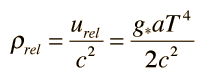
The radiation energy density in astronomy texts is usually put in the form

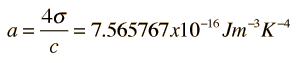
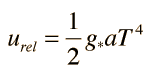
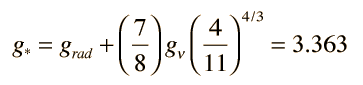
For consistency with other particle quantities that are expressed in terms of the number of degrees of freedom, this is sometimes written in the form
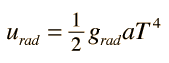
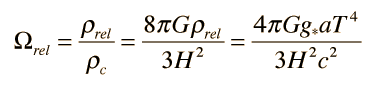
To assess the role of radiation in the expansion of the early universe, one must take a step beyond the simple Newtonian expansion model and include the radiation pressure. When the radiation pressure is included, the effective density represented by the radiation as a function of the scale factor R is
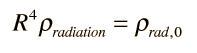
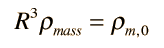
The dependence on the fourth power of R distinguishes the radiation energy density from the mass density, which depends upon the third power of R,
| Matter and radiation in the early universe |
| How old is the universe? |
| Astrophysics |